
Harris County Court Records After Arrest
The Harris County arrest-to-court path often begins in HCSO custody, then moves through the prosecutor and the correct court clerk. HCSO records can show current jail status and the offense inquiry bridge. The Harris County District Attorney's Office decides and prosecutes formal state criminal charges. Felony cases and many district-court criminal records are maintained by the Harris County District Clerk, while some misdemeanors, JP cases, and municipal matters use different public search channels.
A jail booking charge is not the final court charge. Booking data is the custody side of the event, and the court record is the filed-case side. For current custody, housing, SPN, or release questions, use Harris County jail inmate records. For booking-photo access, use Harris County jail mugshots. For court records after a jail arrest, follow the cause number, party name, offense number, setting, disposition, charging document, and clerk index.
The sequence is direct: arrest, booking, first appearance or magistrate review, prosecutor screening, filed charge, court setting, disposition, and any post-case sealing or expunction issue.
Search Harris County Court Records After Arrest
The Harris County District Clerk Search Our Records and Documents page is a key channel for district criminal records. The page requires a registered login because the clerk says login helps protect court documents, but it also states that public case information remains available to everyone after login and can be viewed free of charge. Search fields were not visible before login in the research capture, so the safest wording is registration required, free public case information after login.
| District Clerk Access Point | Type | Use | Notes |
|---|---|---|---|
| Login | Account access | Required for documents and case information | Public case information is free after login. |
| Criminal | Search navigation | District criminal case route | The page also shows Civil/Family navigation. |
| Party Inquiry | Search route | Name-based case lookup after login | Useful when no cause number is known. |
| Public case info | Record view | Charge, setting, disposition, and case status review | Availability depends on public-access rules and record status. |
The District Clerk search page is captured as a login gate, which matters for users expecting an open search form.
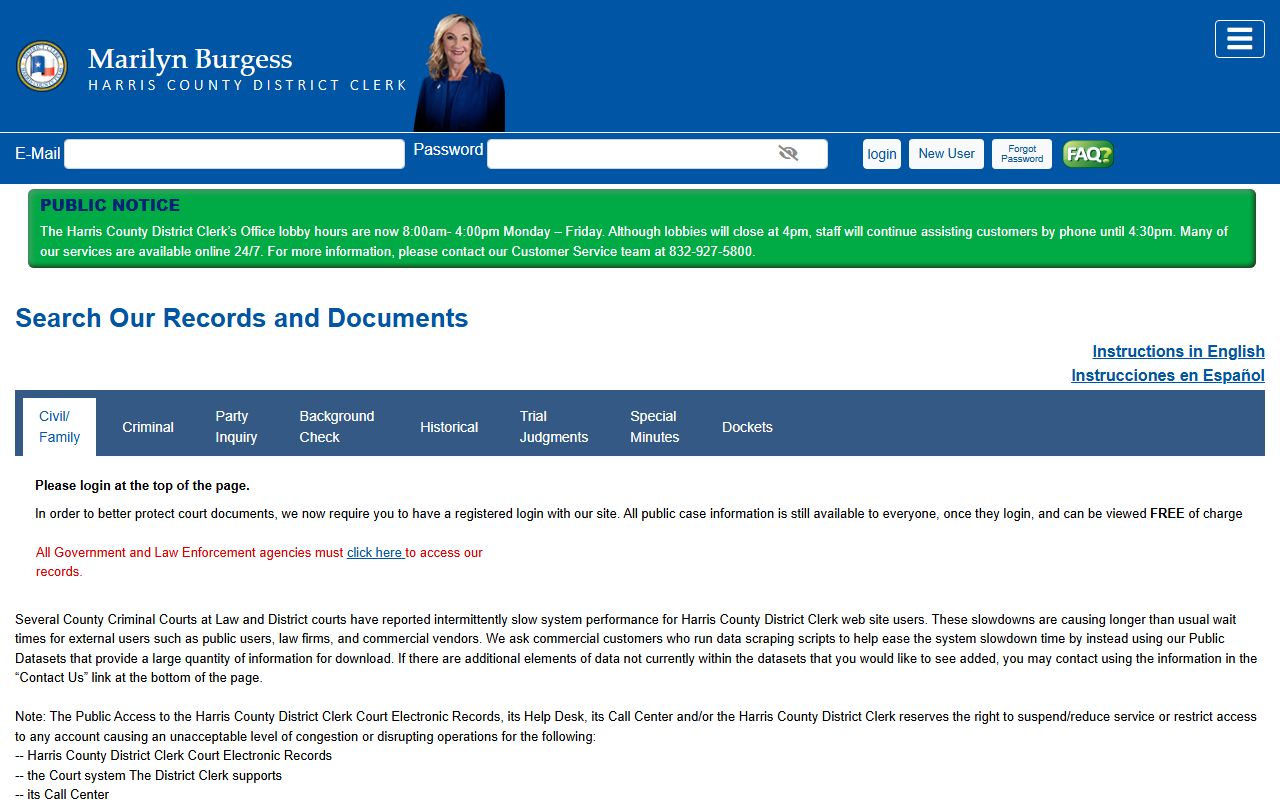
The login requirement does not mean the record is closed. It means public criminal case information is reached after account access.
Harris County Arrest Court Paths
Not every arrest-related court record lands in the same portal. Justice of the Peace courts handle some lower-level matters and publish a Find My Case and Court Date search. Houston Municipal Courts handle fine-only municipal matters and list the Herbert W. Gee Municipal Courthouse, 1400 Lubbock Street, Houston, TX 77002, with public hours and the 713-247-5479 phone line. HCSO warrant materials also point fine-only City of Houston matters to 311 and the municipal court website.
- Start with HCSO Offense Inquiry if the person was just booked and a cause number or setting may already be tied to jail status.
- Use the District Clerk portal for district criminal records and felony-level case information after login.
- Use the Harris County JP Find My Case page for JP-level matters and fine-only case-date searches.
- Use Houston Municipal Courts for City of Houston fine-only municipal court records and court-date questions.
- Submit a written Public Information Act request if a public record exists but is not available through the search portal.
The JP Find My Case page shows a separate public route for cases that do not belong in the district criminal search.
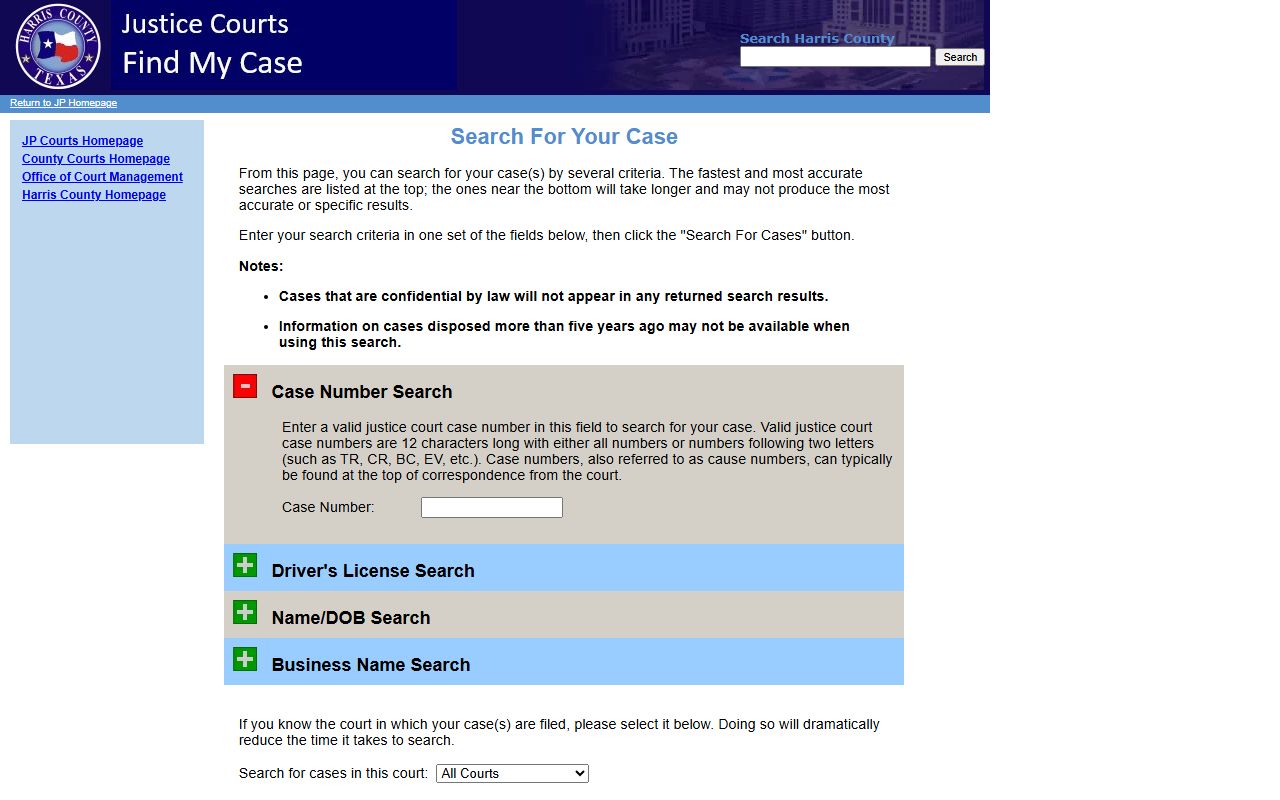
That split is why a failed district-clerk search should not end a Harris County court records after arrest lookup.
Charges Filed After Arrest
After a Harris County jail arrest, the formal court record depends on what prosecutors file and what a grand jury does in felony cases. HCSO FAQ materials explain the grand jury as twelve citizens who decide whether probable cause exists after prosecutors present a felony case. A true bill creates an indictment. A no bill means the grand jury did not return an indictment. Arraignment is the hearing where the indictment or charge is formally presented to the defendant.
| Document | Who Uses It | What It Does | Why It Matters |
|---|---|---|---|
| Complaint | Officer or prosecutor path | States the alleged offense and supporting basis. | May appear early after arrest or in lower-level cases. |
| Information | Prosecutor | Formal written accusation filed by the state in eligible cases. | Can replace or refine a booking charge. |
| Indictment | Grand jury | Formal felony accusation after a true bill. | Often controls the felony court record after grand jury action. |
The Harris County District Attorney's Office at 1201 Franklin, Suite 600, Houston, Texas, phone 713-274-5800, is the prosecutor office for state criminal cases. DA Sean Teare was elected in November 2024. The DA homepage links case, victim, public information, and office contact resources.

The DA channel matters because the prosecutor's filed charge may differ from the arrest charge first seen in jail data.
Harris County Charge Status Records
Charges can change as a case moves. An arrest charge may be amended, reduced, dismissed, indicted, no-billed, or disposed through a plea or verdict. Court records after a jail arrest should be read by status and date, not by the first charge label alone. Disposition means the case outcome or current procedural result. It is not the same thing as a custody release.
| Status | Plain Meaning | Record Reading Tip |
|---|---|---|
| Pending | The case or charge is still active. | Check the next setting and bond conditions. |
| Amended | The filed charge changed after review. | Compare booking charge to the latest court entry. |
| Reduced | The charge level or allegation became less severe. | Look for a later information, plea, or court order. |
| Dismissed | The charge was ended by court or prosecutor action. | Dismissal is not automatic expunction. |
| No Bill | A grand jury did not indict the felony allegation. | Check whether any other charge remains. |
| Disposed | The case reached a recorded outcome. | Read the disposition, date, and sentence or order fields. |
Bond and Warrants After Arrest
Harris County bond records after arrest sit between jail custody and court process. HCSO states bonds are accepted in person at 700 N. San Jacinto Street, Houston, TX 77002, and the warrants page says the Bonding Desk is open 24 hours a day, seven days a week, including holidays. HCSO also links an online cash bail payment path through GovPayNow or AllPaid. Bond types include cash bond, surety bond, personal bond, and pretrial release bond.
| Bond or Hold Term | Meaning in Harris County Records |
|---|---|
| Cash bond | Cash posted in the bail amount to secure appearance. |
| Surety bond | Bond posted through an approved bonding company that charges a fee. |
| Personal bond or PR bond | Release on a promise to appear when the court or magistrate approves it. |
| Pretrial release bond | Judge-approved personal bond based on Pretrial Services information. |
| No-bond or hold | Custody status that can block release because of another case, warrant, parole issue, federal hold, or ICE detainer. |
HCSO's warrants search is limited. It covers Class A and Class B misdemeanor warrants and other processes issued by a Harris County Criminal Court at Law. It is not a statewide or all-warrant database. HCSO says the list updates daily and warns users not to try to apprehend anyone listed.
Charges vs Convictions
A Harris County court record after arrest can show a charge long before it shows a conviction. A charge is an accusation filed into the criminal process. A conviction is the result of a guilty plea, verdict, or other legally sufficient finding. Treating the two as the same is one of the main errors in reading arrest-linked court records.
| Issue | Charge | Conviction |
|---|---|---|
| Stage | Accusation after arrest or prosecutor review. | Final or recorded finding after plea, verdict, or judgment. |
| Proof level | Can rest on probable cause or filed accusation. | Requires the legal standard for conviction. |
| Record use | Shows what was alleged and filed. | Shows the case outcome and may affect sentence or history. |
Sealed and Expunged Records
Texas public access law starts with existing government records, but not every arrest-linked court record stays public forever. Texas Code of Criminal Procedure Chapter 55 governs expunction for qualifying arrest and criminal records. Expunction is not the same as a court record being hard to find online. It is a legal order process tied to eligibility, case outcome, notice, and agency compliance.
| Issue | Sealed | Expunged |
|---|---|---|
| Public visibility | Public access is limited or restricted by order. | The record is treated under expunction order requirements. |
| Record existence | The record may still exist with restricted access. | Agencies must follow the expunction order for covered records. |
| Best source | Court order and clerk record. | Chapter 55 process and the court that issued the order. |
Public access rule: Texas Government Code Chapter 552 gives access to existing public records unless an exception applies; it does not force agencies to create answers or legal opinions.
Request Missing Court Records
If a Harris County court record after a jail arrest is not visible online, send the request to the office that holds the record. Use the District Clerk for district criminal case records, the JP or municipal court system for lower-court matters, HCSO or county records channels for jail and offense records, and the DA public-information process for prosecutor-held public records. The DA's public information page states requests must be written and submitted through its designated methods.
A useful request gives the booked name, date of birth if known, SPN, arrest date, offense number, cause number, court, and exact record sought. Ask for existing records. Do not frame the request as legal advice, research, or a question about what should have happened in court.
Note: A person can be released from jail while the court case remains pending, so custody status and court status must be checked separately.